


CHAPTER A2 – WHAT IS VALUE?
| CHAPTER A2 – WHAT IS VALUE? | STATUS & REVISION HISTORY | ||
|---|---|---|
| Original Standard | May 1999 | |
| Review by Forestry Australia Valuation Working Group | Sept 2020 | Main revisions are:
|
| Reviews by NZIF | Oct 2020 | Reworked chapter to comprehensively cover reporting of value. |
| CURRENT STATUS | July 2025 | Released as final |
PDF available to download here
Introduction
The previous Chapter A-1 distinguished different purposes for valuation. It acknowledged that not all purposes might be satisfied by the same value. In general, though, forest valuers have been increasingly finding that most applications can be met using the value that would be realised in a near-term transaction.
One of the biggest influences encouraging convergence has been a sea-change in recommended practice from the accounting profession. This has been especially evident in the approach that the International Accounting Standards Board (IASB) has taken towards reporting the value of biological assets. Previous preference had been to report values based on accumulated cost. This had the advantage of referring to actual financial records, with the corresponding benefits of tangible evidence and reduced subjectivity. Inconveniently, though the assigned ‘values’ could come to bear little resemblance to what the assets were capable of realising in the event of sale.
Two styles of reference to transaction-evidenced values have become most common. These are ‘market value’ and ‘fair value’. The first has been a preferred term within the ranks of valuers. With the development of the new financial reporting standards, there was evident concern that while ‘market value’ was well established, the prevailing definitions were too varied and thereby too loose. The IASB instead chose to refer to its extractions from transaction-based evidence as ‘fair value’.
As the following sections indicate, practitioners may perceive some subtle differences between market value and fair value. From some quarters there has been an inclination to combine both adjectives and refer to ‘fair market value’. While potentially tautologous, the double-barrelled reference does convey that the users are attempting to comply with both definitions at once.
Expressions of professional opinion on the assessment and reporting of asset value include those shown in Table 2-1.
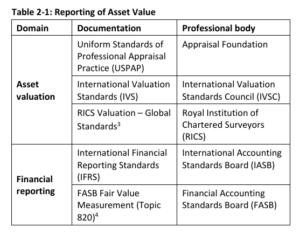
Given the organisations’ purpose, they have needed to define ‘market’, ‘fair’ and other forms of value. Examples of their definitions are demonstrated in the following.
IVSC
The International Valuation Standards Council (IVSC) definitions (in IVS104 Bases of Value) include:
Market value is the estimated amount for which an asset or liability should exchange:
- on the valuation date;
- between a willing buyer and a willing seller;
- in an arm’s length transaction;
- after proper marketing; and
- where the parties had each acted knowledgeably, prudently and without compulsion.
The concept of Market Value presumes a price negotiated in an open and competitive market where the participants are acting freely. The Market Value of an asset will reflect its highest and best use. Equitable Value is the estimated price for the transfer of an asset or liability between identified knowledgeable and willing parties that reflects the respective interests of those parties.
https://asc.fasb.org/imageRoot/81/118196181.pdf
Equitable Value requires the assessment of the price that is fair between two specific, identified parties considering the respective advantages or disadvantages that each will gain from the transaction. In contrast, Market Value requires any advantages or disadvantages that would not be available to, or incurred by, market participants generally to be disregarded.
Investment Value is the value of an asset to a particular owner or prospective owner for individual investment or operational objectives. Investment Value is an entity-specific basis of value. Although the value of an asset to the owner may be the same as the amount that could be realised from its sale to another party, this basis of value reflects the benefits received by an entity from holding the asset and, therefore, does not involve a presumed exchange. Investment Value reflects the circumstances and financial objectives of the entity for which the valuation is being produced. It is often used for measuring investment performance.
USPAP
The Appraisal Standards Board (ASB) of the Appraisal Foundation is based in Washington, D.C. It develops, interprets and amends the Uniform Standards of Professional Appraisal Practice (USPAP).
USPAP defines appraisal as:
- (Noun) ‘the act or process of developing an opinion of value; an opinion of value.’
- (Adjective) ‘of or pertaining to appraising and related functions such as appraisal practice or appraisal services.’
Market value is defined as:
A type of value, stated as an opinion, that presumes the transfer of a property (i.e., a right of ownership or a bundle of such rights), as of a certain date, under specific conditions set forth in the definition of the term identified by the appraiser as applicable in an appraisal.
The 2020-21 edition of USPAP includes Advisory Opinion 22, addressing the issue of how ‘market value’ affects the scope of work in a real property appraisal assignment. It emphasizes the requirement to declare the criteria that are being employed in distinguishing ‘market value’ from other forms of value. An example definition of Market Value is provided, with careful qualification to declare that it is tabled, ‘… only as an example’.
Market Value means the most probable price which a property should bring in a competitive and open market under all condition’s requisite to a fair sale, the buyer and seller each acting prudently and knowledgeably, and assuming the price is not affected by undue stimulus. Implicit in this definition are the consummation of a sale as of a specified date and the passing of title from seller to buyer under conditions whereby:
- Buyer and seller are typically motivated;
- Both parties are well informed or well advised and acting in what they consider their own best interests;
- A reasonable time is allowed for exposure in the open market;
- Payment is made in terms of cash in U.S. dollars or in terms of financial arrangements comparable thereto; and
- The price represents the normal consideration for the property sold unaffected by special or creative financing or sales concession granted by anyone associated with the sale.’
A footnote to the definition observes:
This example definition is from regulations published by federal regulatory agencies pursuant to Title XI of the Financial Institutions Reform, Recovery, and Enforcement Act (FIRREA) of 1989 between July 5, 1990, and August 24, 1990, by the Federal Reserve System (FRS), National Credit Union Administration (NCUA), Federal Deposit Insurance Corporation (FDIC), and the Office of Comptroller of the Currency (OCC). This definition is also referenced in regulations jointly published by the OCC, FRS, and FDIC on June 7, 1994, and in the Interagency Appraisal and Evaluation Guidelines, as revised and updated December 2010.
This definition is noted as historically it has found frequent mention in the instructions issued by US-based forest investors. In earlier versions of USPAP, this specific definition was formally declared in the main body of the Standards. The Appraisal Foundation’s stance has since changed to permit more latitude in definitions. There is then an associated obligation to explicitly declare just what the definition is.
RICS
The Royal Institution of Chartered Surveyors is a professional body promoting and enforcing international standards in the valuation, management and development of land, real estate, construction and infrastructure.
The version of RICS Global Standards applicable at the time of writing (issued November 2019, effective from 31 January 2020) adopts and applies the IVSC definitions of Market Value, Equitable Value and Investment Value.
IFRS
The International Financial Reporting Standards (IFRS) Foundation is the parent entity of the International Accounting Standards Board (IASB), an independent accounting standard-setter.
International Financial Reporting Standards (IFRS) 13-Fair Value Measurement 2012 sets out a framework for measuring fair value and became effective 1 January 2013.
IFRS defines fair value as the price that would be received to sell an asset or paid to transfer a liability in an orderly transaction between market participants at the measurement date.
When measuring fair value, an entity uses the assumptions that market participants would use when pricing the asset or the liability under current market conditions, including assumptions about risk.
FASB
The Financial Accounting Standards Board (FASB) is an independent nonprofit organization responsible for establishing accounting and financial reporting standards for companies and nonprofit organizations in the United States. The Board has the authority to establish and interpret generally accepted accounting principles (GAAP). In recent years, the FASB has been working with the IASB on an initiative to improve financial reporting and the comparability of financial reports globally.
Accounting Standards Codification 820 is part of the FASB’s GAAP guidance. It defines fair value using the same words as IFRS13, i.e. ‘… the price that would be received to sell an asset or paid to transfer a liability in an orderly transaction between market participants at the measurement date.’ A forest may provide the security for a loan. The lending institution needs reassurance that the realisable value of the forest asset is sufficient to repay the loan in the case of default.
Fair value vs market value
The IFRS/FASB definition of Fair Value has similarities to the IVSC definition of Equitable Value. IVS104 Bases of Value observes that ‘Equitable Value is a broader concept than Market Value. Although in many cases the price that is fair between two parties will equate to that obtainable in the market, there will be cases where the assessment of Equitable Value will involve taking into account matters that have to be disregarded in the assessment of Market Value, such as certain elements of Synergistic Value arising because of the combination of the interests.’
Investopedia states that ‘In its broadest economic sense, fair value represents the potential price, or the value assigned, to a good or service, taking into account its utility, supply and demand for it, and the amount of competition for it. Although it infers an open marketplace, it is not quite the same as market value, which simply refers to the price of an asset in the marketplace (not intrinsic worth).’
https://www.investopedia.com/terms/f/fairvalue.asp
Financial reporting standards in Australia and New Zealand
In Australia and New Zealand, IFRS 13 Fair Value Measurement has been adopted as AASB 13 and NZ IFRS 13 respectively. They are the overarching standards under which sit AASB 141 and NZ IAS 41 Agriculture, AASB 116 and NZ IAS 16 Property, Plant and Equipment, AASB 140 and NZ IAS 40 Investment Property, and AASB 16 and NZ IFRS 16 Leases.
With the introduction of IFRS 13, references to valuation methodology in the other IFRS documents were removed. The previously noted definition is instead expected to apply, i.e. ‘… the price that would be received to sell an asset or paid to transfer a liability in an orderly transaction between market participants at the measurement date.’ (AASB 13 (2015)/ NZ IFRS 13).
Market participants are defined in AASB 13 / NZ IFRS 13 as ‘Buyers and sellers in the principal (or most advantageous) market for the asset or liability that have all of the following characteristics:
a) They are independent of each other, i.e. they are not related parties (as defined in AASB124 / NZ IAS 24) , although the price in a related party transaction may be used as an input to a fair value measurement if the entity has evidence that the transaction was entered into at market terms.
b) They are knowledgeable, having a reasonable understanding about the asset or liability and the transaction using all available information, including information that might be obtained through due diligence efforts that are usual and customary.
c) They are able to enter into a transaction for the asset or liability.
d) They are willing to enter into a transaction for the asset or liability, i.e. they are motivated but not forced or otherwise compelled to do so.’ (AASB 13 2015 Pp 20-21, NZ IFRS 13 p 20)
AASB 141 and NZ IAS 41 Agriculture. These standards prescribe the accounting treatment, financial statement presentation, and disclosure related to the biological component of the forest assets. They require that biological assets are valued at fair value less costs to sell. Costs to sell ‘are the incremental costs directly attributable to the disposal of an asset, excluding finance costs and income taxes.’
AASB 116 and NZ IAS 16– Property, Plant and Equipment. These standards apply to property, plant and equipment (including land and buildings) used to develop or maintain the assets.
AASB 140 and NZ IAS 40 Investment Property. These standards prescribe the accounting treatment for investment property and related disclosure requirements.
AASB 16 and NZ IFRS 16 Leases. These standards set out the principles for the recognition, measurement, presentation and disclosure of leases.
Australia currently has no authoritative guidance specific to the valuation of Australian Carbon Credit Units (ACCUs) issued by the Clean Energy Regulator (CER) in their role as part of the Australian Government’s Emissions Reduction Fund or carbon credits issued by other schemes. In the absence of a specific standard, two relevant standards are:
- AASB 138 Intangible Assets; and
- AASB 13 Fair Value Measurement.
Currently, there is no specific standard for the recognition of units received under the Emissions Trading Scheme (ETS). New Zealand units are issued by the New Zealand Government under applicable legislation. In the absence of a specific standard, the relevant standards is:
- NZ IAS 20 Government Grants.
Definition of value used in these standards
The focus of these standards is the estimation of the market value of a tree crop or forest or bundle of assets. Recognising the wider examples that have been previously described in this section, a workable version is as follows:
Market value is the amount for which the defined asset or liability should exchange:
- on the date of the valuation;
- between a willing buyer and a willing seller;
- in an arm’s length transaction;
- after proper marketing; and
- wherein the parties had each acted knowledgeably, prudently and without compulsion.
Linkage to Accounting Standards
Despite the different terms and definitions, it is anticipated that in most cases, the fair value of a tree crop or forest that is reported in financial statements will be the same as the market value estimated by the valuer.
Last date updated: 31/07/2025