

CHAPTER A1 – PURPOSES OF FOREST VALUATION
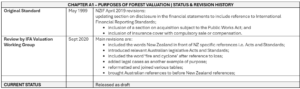
| CHAPTER A1 – PURPOSES OF FOREST VALUATION | STATUS & REVISION HISTORY | ||
|---|---|---|
| Original Standard | May 1999 | NZIF April 2019 revisions: updating section on disclosure in the financial statements to include reference to International Financial Reporting Standards;
|
| Review by Forestry Australia Valuation Working Group | Sept 2020 | Main revisions are:
|
| CURRENT STATUS | July 2025 | Released as final |
PDF available to download here
Purpose matters
A forest valuation is required for a particular purpose. There is a prospect that the same valuation may also be suitable for other purposes, but this cannot be assured. Some forms of valuation are purpose specific as the following review of applications explains.
Sale and purchase
A common reason for forest valuation is to assist in negotiations for the sale and purchase of a forest. For example, a seller may wish to establish a reserve price, and a buyer may wish to determine a reasonable price to pay for an asset.
Disclosure in the financial statements of business entities
Forest valuations are commonly required for reporting of financial performance. There is a requirement for assets to be disclosed in the statement of financial position under the Australian Corporations Act 2001 and the New Zealand Companies Act 1993 and Financial Reporting Act 1993. This may be achieved by either a formal fair valuation process or by observing other accounting conventions. International Financial Reporting Standards (IFRS) 13-Fair Value Measurement 2012 sets out in a framework for measuring fair value and became effective 1 January 2013. Other standards are specified by the regulators of the respective stock exchanges and accounting standards boards.
Compulsory sale or compensation, including insurance cover
In the cases of a compulsory sale or compensation for a loss (e.g. fire, cyclone damage), the owner will require fair compensation for the loss of the tree crop in addition to any loss associated with any limitations imposed on the use of the land. In compulsory sale or compensation situations the owner is not a willing seller. The owner requires to be put in the same financial position as they would have been in, assuming no loss and retained ownership of the tree crop. Tree crop values for compensation purposes include assessments of the appropriate level of tree crop insurance cover.
Compulsory acquisition
In Australia, the compulsory acquisition of land is legislated under Section 51 (xxxi) of the Australian Constitution. It can be carried out at federal, state, territory or local government levels based on various state land administration acts.
In New Zealand, if compulsory sale takes place in accordance with section 62 of the New Zealand Public Works Act 1981, then no allowance can be made on account of the taking of an interest in the land being compulsory. The Act prescribes that the tree crop market value is assessed on a before and after basis. The process should consider all impacts on the tree crop affected. The difference between the before and after situation is the level of compensation required. This difference in value represents the market value of the tree crop on the land that is to be acquired. The impact that the acquisition of this portion of the tree crop has on the market value of the tree crop in the remainder of the forest also need to be considered.
Examples of impacts on the market value of compulsory acquisition on the remaining tree crop are:
- the possible increase in roading costs; and
- the possible increase in the risk of wind damage on the cut face offset by improved fire accessibility.
Property division
This may include property division for business restructuring, partnership dissolution or a matrimonial property split. If land includes trees, the value of the trees may be significant in the total value of the property.
Equity transfer (sales of shares)
The value of the shares of a forest owning entity may be significantly influenced by the value of the forest.
Collateral
A forest may provide the security for a loan. The lending institution needs reassurance that the realisable value of the forest asset is sufficient to repay the loan in the case of default.
Taxation
Different tax treatments apply to land and forest. When the trees and land are sold in the same transaction, the respective components must be itemised. The purchaser of trees is entitled to deduct the cost of the trees from the eventual proceeds from their future sale. It is therefore important to the purchaser to allocate the total purchase price of the forest into land and tree crop components. It may become further necessary to distribute the total value of the tree crop between crop types and age classes.
Forest planning and management
Forest valuations prepared on a consistent basis over time provide a stable reference for comparison of alternative management options and investments.
Stewardship
Comparative forest valuations are a tool to measure the performance of management in their role as stewards. Valuations developed for this purpose may contribute to calculation of the forest manager’s remuneration.
Legal cases
Comparative forest valuations are sometimes called for in legal disputes, such as fraudulent misrepresentations, before- and after- cases, product price setting in related-party issues, or for forests owned or managed by companies under administration.
Last date updated: 31/07/2025