


CHAPTER B7 – DESCRIBING COSTS
| CHAPTER B7 – DESCRIBING COSTS | STATUS & REVISION HISTORY | ||
|---|---|---|
| Original Standard | May 1999 | NZIF April 2019 revisions:
|
| Review by Forestry Australia Valuation Working Group | Sept 2020 | Main revisions are:
|
| CURRENT STATUS | July 2025 | Released as final |
PDF available to download here
Purpose
The purpose of this standard is to ensure the completeness, reliability and consistency of all costs specified in the forest description.
Standard B7.1 – Completeness of costs
The forest description shall ensure that:
- costs are declared for all operations implicit in the description of the forest, which are relevant for the purpose of the forest description;
- costs include all forest level costs of being in business (such as rates, land occupation costs, salaries and associated costs, consultants or management fees, buyer’s margin as applicable in stumpage sales, indirect operations, e.g. protection and animal control);
- costs should adequately represent the overheads and administration costs associated with the forest asset. Consideration should be given to the extent to which corporate costs are related to the forest or are associated with other activities;
- costs associated with investment structure (e.g. fund management and trustee costs) should not be included;
- costs are calculated in such a way that accurately reflect expected future costs – particularly pertinent to overhead costs which can be represented on the basis of $/m3 (or tonne), $/ha, a percentage of operational costs or as a single fixed cost; and
- the valuation should clearly indicate if a provision has been made for working capital.
Standard B7.2 – Reliability of costs
The forest description shall:
- identify the source of costs;
- describe models of cost (e.g. logging cost/piece size model);
- note the relevance of externally sourced costs;
- describe any assumed changes in future real or nominal costs;
- compare current actual costs with those assumed in valuing the asset and describe the rationale for any differences; and
- provide a reconciliation to independent sources.
Standard B7.3 – Consistency of costs
The forest description shall ensure:
- consistency of costs with other sections of the forest description;
- internal consistency with no double counting (e.g. treatment of supervision costs);
- external consistency (e.g. with land value or capital value. Does the land value include road formation but exclude road gravelling (NZ: metalling) and culverts); and the currency and GST status of the costs is declared
Standard B7.4 – Disclosure of cost movements
The forest description shall describe:
- assumed future real cost changes (including zero change);
- the results of any analysis that has been done including:
− method of forecast movement
− statistical analysis showing forecast trend and
− sensitivity analysis; - any assumed movements in factors impacting on future costs.
Standard B7.5 – Applicability
The forest description shall contain a statement describing the author’s view as to the applicability of the costs for the purposes of the valuation. The statement shall include the rationale for using the costs adopted in the valuation.
GUIDANCE NOTES ON COSTS USED IN FOREST VALUATION
Background
The current management of a forest will have specific costs associated with it. These are likely to provide useful guidance to the valuer as to the appropriate costs to use when valuing the forest. However, the valuer should also look to wider evidence to determine the costs to include.
Objective
The objective is to look at costs from the perspective of the market.
Approach
The valuer needs to consider what costs would be recognised by the market. In the case of young stands, where a cost compounding approach is being considered, costs such as a return on the land value or the overhead costs associated with the current owner may or may not be included. Likewise, in developing cashflows for the forest, the valuer need not use current costs if it is possible the forest might be managed differently. Examples might include a more efficient management structure, or differences in costs that might occur through outsourcing various operations (e.g. in-house harvesting crews versus contracting). Conversely additional costs may be required for the business to operate effectively.
Working capital
A first inclination in preparing cashflow projections for forest assets is to assume that funding flows will coincide with the dates that produce is sold, or costs are incurred. To consider some examples:
- a load of logs from the forest crosses a weighbridge, promptly generating an invoice on behalf of the forest owner to the sawmill buying the logs; or
- the same weighbridge details are the basis for an invoice from the harvesting and cartage contractors to the forest owner, requiring payment for their services.
In practice, although the invoices may be submitted promptly, neither leads to an immediate flow of funds. The credit policies of the respective parties determine when the payments are actually made. Thus:
- the invoices to the sawmill are summarised in a statement at the end of the month and once this is received by the customer, they have 20 days in which to make payment; and
- likewise, the harvesting and transport contractors may summarise their accumulated invoices, and for the sake of demonstration it is assumed that these are submitted fortnightly (once again with 20 days to pay).
When modelling the cashflows of a collective business, the gap between when the obligation to pay is incurred and the corresponding funds are actually received can be material. Discounted cash flow (DCF) analysis is based on the premise that there is a time value to money. If there is a delay in receiving money, this represents an opportunity cost because had the funds been received, they could have been put to other productive use. There are several possible approaches to addressing this:
- a detailed representation of actual amounts and timing of operations (on a daily, weekly or monthly resolution rather than annual basis);
- a generalised formulaic treatment designed to proxy the need for additional cash (see example below); or
- to change the timing of the cashflow components of the DCF model to reflect cash in/out rather than invoicing, e.g. if payments to contractors are made on a 30-day basis, rather than assuming mid-year occurrence, the values could be discounted from a point equivalent to mid-year plus 30 days.
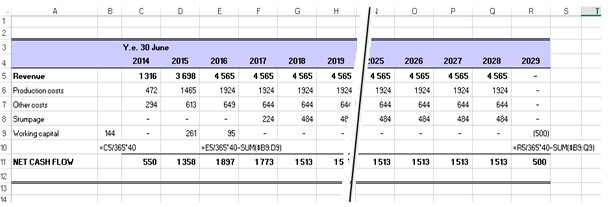
A simple format that recognises working capital requirements is shown below. In this case the calculation is only based on changes in the revenue line.
Overhead costs
Note:
- in this case, it is assumed that the cash from revenues is not actually received until 40 days (on average) after invoices are raised;
- amounts appear in the working capital row as the quantity of revenue increases from one year to the next and, if the revenue remains the same, no working capital event appears;
- a final negative entry appears in 2029 when the accumulated working capital amount is released; and entries in the working capital row are included with the other costs that are deducted from the revenue line to produce net cashflow.
A more refined example can use a similar formulation but consider additional items such as changes in payables and inventory levels.
Overhead costs are typically represented on the basis of $/m³ (or tonne), $/ha, a percentage of operational costs or as a single fixed cost. The valuer needs to consider the most appropriate means of modelling overheads for the forest in question. For example, in the case of an even age-class forest, the total cost applicable to the current crop derived from a $/m3 calculation, will remain relatively constant over the entire rotation. Conversely the total cost calculated from a $/ha rate will decline as the current crop is harvested (when considering just current crop cashflows).
Last date updated: 31/07/2025