


CHAPTER B8 – DISCLOSURE OF PRICES
| CHAPTER B8 – DISCLOSURE OF PRICES | STATUS & REVISION HISTORY | ||
|---|---|---|
| Original Standard | May 1999 | NZIF April 2019 revisions:
|
| Review by Forestry Australia Valuation Working Group | Sept 2020 | Main revisions are:
|
| CURRENT STATUS | July 2025 | Released as final |
PDF available to download here
Purpose
Purpose The purpose of this standard is to provide for the full disclosure of product prices, their source and applicability for the use to which the valuation will be put.
Standard B8.1 – Disclosure of prices
The forest description shall disclose:
- tree species or species mix;
- prices for each log grade at point(s) of sale (exclusive of GST if applicable) – the log grades should be the same as those in the
yield tables; - units of sale (e.g. m3, tonnes, JAS m3);
- currency in which the price was negotiated;
- exchange rate to convert price to (if applicable);
- point(s) of sale;
- other price point(s) disclosed in the valuation model;
- costs from point of sale back to other price point(s);
- conversion factors used to convert units of sale to units in yield tables (if applicable); and
- any specific adjustments to derived forest description prices.
Standard B8.2 – Disclosure of sources of price
The forest description shall describe:
- log grades from which prices are derived;
− name
− location of market(s) or port(s)
− specification – any material specification (e.g. length, small end diameter, knots, form, straightness, density, ovality, eccentricity, nodality, defect core, age, rot)
− the yield table grade to which each market grade applies (if applicable)
− the relationship between the log pricing information and the yield table grades, and any adjustments that were made to align prices with the yield table grades and
− purpose or end use; - Any market information used in support of prices for source grades including (where relevant);
− sources of data
− reliability of data
− volumes traded
− price volatility; - The derivation of price at point of sale by grade including:
− the timespan over which the data was collected
− the scope and depth of the data and
− any analysis undertaken (time series analysis, method of smoothing).
Standard B8.3 – Disclosure of market assumptions
The forest description shall describe:
- any material wood supply agreements;
- the markets where harvest volumes are envisaged to be sold; and=
- the limits on volumes sold in each market.
Standard B8.4 – Disclosure of price movements
The forest description shall describe:
- assumed future real price changes (including zero change);
- the results of any analysis that has been done including:
− method of forecast movement
− statistical analysis on forecast trend
− sensitivity analysis; and - any assumed movements in factors impacting on future log prices, such as shipping costs, port costs and currency exchange rates and components of any agreed log price indexing mechanisms e.g. CPI, APLPI, MGP10 price etc.
Standard B8.5 – Applicability
The forest description shall contain a statement describing the author’s view as to the applicability of the prices for the purpose of the valuation.
The statement shall include the rationale for the pricing philosophy and methodology adopted and some comparison with the practice used by others.
GUIDANCE NOTES ON LOG PRICES
Marketing assumptions
Forest valuations are typically sensitive to log price assumptions.
It is important to provide details of the pricing philosophy used and any assumptions about pricing points. The log marketing scenario used must be realistic and well described.
For example, all prices may be based on parity with current export log prices. Alternatively, some grades may be assumed to be sold to domestic processors and other grades exported. Currently, in some locations there may only be limited marketing opportunities for some log grades. However, there is a strong likelihood of new processing facilities being built in the short term which may offer higher returns to the forest owner.
The valuer often has to make arbitrary decisions about the markets into which logs will be sold in the future. A full discussion on any assumptions should be provided.
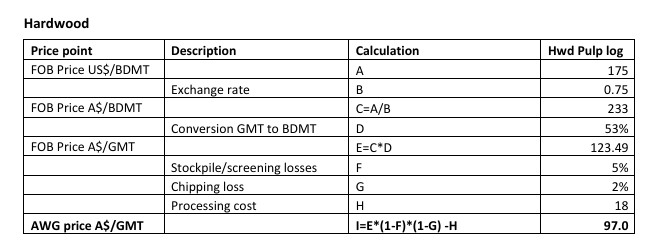
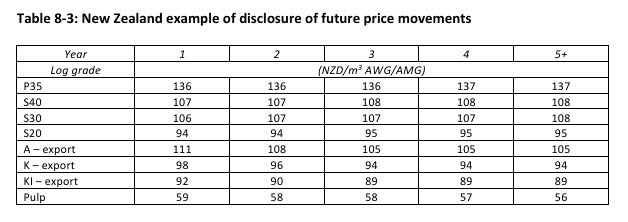
Examples of price disclosures at different common price points are available in Tables 8-1 to 8-2. Table 8-3 provides an example of disclosure of future price movements.
Benchmarking Sales of mature forests, and cutting right (stumpage) sales in particular, provide market evidence of implied log prices, an outlook of log prices for the short and medium term that resulted in a sale, and purchase prices that satisfied both the seller and the buyer. These implied log prices provide an indication of the combination of discount rate and log price outlook held by these market participants.
In instances where historic and current log price information has been provided for the forest being valued, the valuer should (where possible) benchmark the log prices provided with other publicly available information and data supplied by other entities selling similar log grades.


Last date updated: 31/07/2025