
MEDIA RELEASE
Wednesday 6 May 2026
Predation, Not Habitat Loss, Is Primary Driver of Swift Parrot Decline
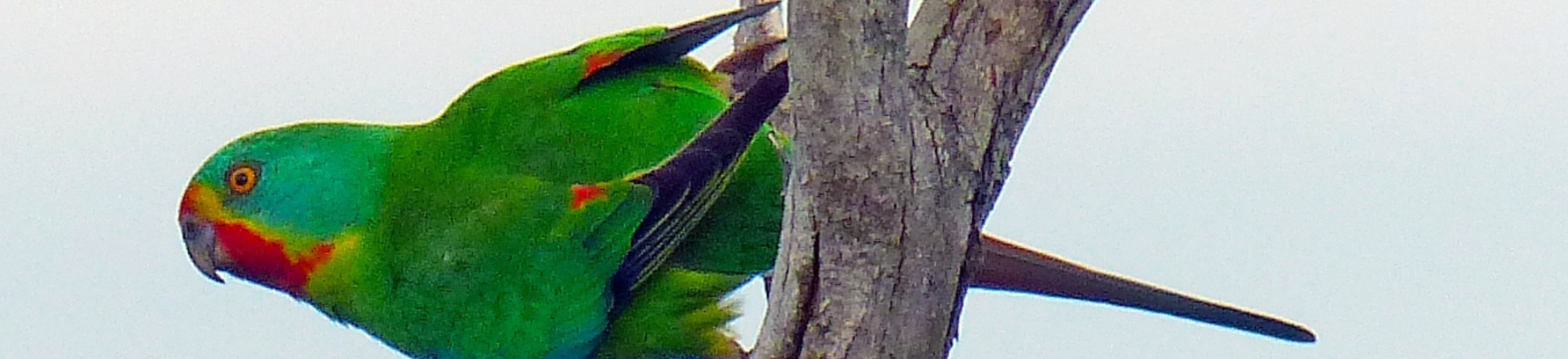
A critically endangered parrot facing functional extinction by the end of this decade is being killed off primarily by an introduced predator, not by native forest harvesting, and a new peer-reviewed study argues that conservation strategies need to catch up with that reality.
The finding, published in Australian Forestry, challenges the widely held view that habitat loss from native forest harvesting is the central cause of the swift parrot’s collapse. Independent researcher Simon Grove reviewed the body of published research to test two competing explanations for the decline, concluding that the evidence base firmly favours predation over habitat loss as the primary driver.
Swift parrots breed only in Tasmania. The species has no other known breeding range, making its population uniquely vulnerable — and uniquely dependent on getting the conservation response right.
Grove’s paper sets out two hypotheses. The first, which he terms the forest habitat narrative, holds that the decline is primarily or exclusively driven by habitat loss, with native forest harvesting as the critical mechanism. The second, the predation narrative, holds that the population is being suppressed by the killing of nesting females and their eggs or broods by sugar gliders, an introduced species.
Neither the straightforward forest habitat hypothesis, nor a more nuanced version linking sugar glider predation to the effects of forest disturbance, is well supported by the evidence. The predation hypothesis, by contrast, is grounded in empirical observation and supported by what the paper describes as apparently robust statistical modelling.
The implications for conservation are direct. A strategy focused solely on protecting existing breeding habitat would, the study concludes, “make negligible material difference to the swift parrot’s fate in the short term” — doing little more than ensuring the remaining birds continue to be predated when nesting. “An all-out focus on predation mitigation remains the only strategy with at least the potential to avoid species extinction.”
Author Simon Grove is unequivocal about what the evidence demands. “Unless we focus all-out on finding practical ways to reduce predation on nesting swift parrots at scale, the species seems doomed to extinction,” he said. “In contrast, directing outrage towards the highly regulated forestry sector does nothing to further the species’ chances of surviving into the next decade — in fact, it detracts from where the real work is needed and is therefore contributing to the problem rather than the solution.”
The paper was accepted in February 2026 and published online on 22 March 2026.
For more information: Grove, S. J. (2026). What is driving the continued decline of critically endangered swift parrots? A re-examination of the research papers. Australian Forestry, 1–34. https://doi.org/10.1080/00049158.2026.2634414
About Forestry Australia
Forestry Australia is the peak professional body for foresters, forest scientists, private forestry and commercial tree growing in Australia. With more than 1,100 members spanning research, industry and government, Forestry Australia advances the profession through education, events, policy engagement and scientific publication. It publishes Australian Forestry, one of the longest-running forestry journals in the Southern Hemisphere.
About Australian Forestry
Australian Forestry is the peer-reviewed scientific journal of Forestry Australia, now in its 100th year of continuous publication. The journal covers forest science, management, policy and ecology, with a particular focus on Australian and Southern Hemisphere conditions. It is published by Taylor & Francis and indexed in major scientific databases. The current managing editor is Dr Mohammad Ghaffariyan of the University of the Sunshine Coast.
ENDS
Media contact: Jason Ross, Marketing and Communications Manager, Forestry Australia. 0448 190 055 / communications@forestry.org.au