
Friday 29 May 2026
Why a Rogue Nematode Strain, Not Kamona, Ended an NSW Sirex Outbreak
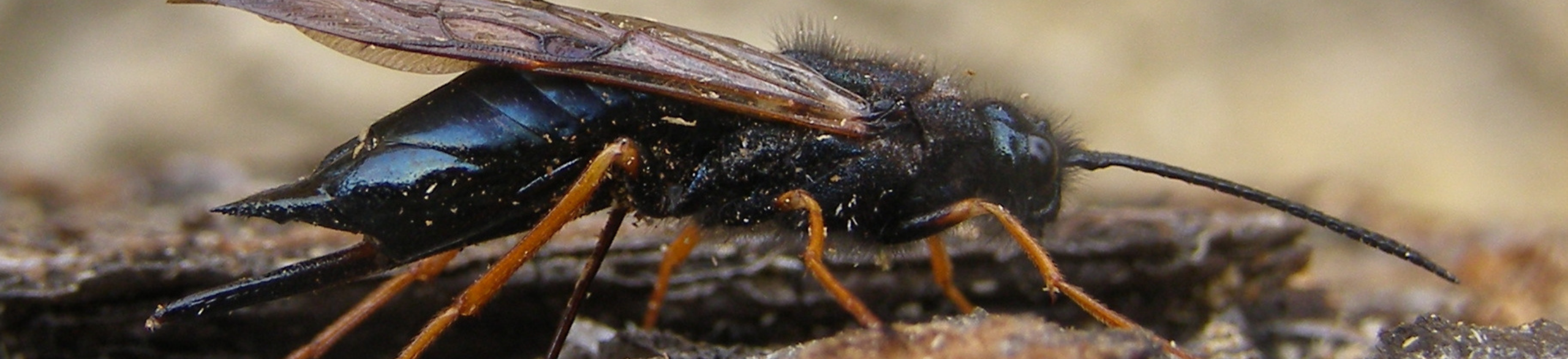
Biological control in forest plantations can confound even the scientists designing it, and a new NSW study has delivered a striking example. A cryptogenic nematode strain, not the Kamona inoculant deliberately released by researchers, was responsible for collapsing a Sirex wood wasp outbreak in an un-thinned pine plantation, according to a peer-reviewed study in the latest edition of Australian Forestry, co-authored by A.J. Carnegie, M. Nagel, D. Sargeant, K.N.E. Fitza and H.F. Nahrung.
The study tracked a Sirex noctilio outbreak in an un-thinned Pinus radiata plantation in NSW from 2015, when the attack was first detected, through to 2020. The plantation was 11 years old at discovery and carrying between 3,000 and 6,500 stems per hectare, stocking levels far above commercial norms, driven by years of ineffective pine wildling control.
Beginning in 2016, researchers inoculated naturally struck trees with the Kamona strain of the nematode Deladenus siricidicola. By 2019, a total of 16 million nematodes had been released across the site. By 2020, the outbreak had effectively subsided.
Ground plot surveys showed 40 per cent of trees had been struck by Sirex, with suppressed trees and wildings accounting for the overwhelming share of attack. The parasitic wasp Ibalia leucospoides contributed to control, parasitising roughly 30 per cent of Sirex larvae. Nematode parasitism climbed from under 5 per cent at the outbreak’s outset to 95 per cent of all emerging female sirex by 2019. Taken at face value, that trajectory looked like a biocontrol success.
But molecular analysis complicated that conclusion entirely.
None of the nematodes recovered from emerging Sirex was Kamona. All belonged to a newly identified strain, Lineage D, a cryptogenic organism whose origin and arrival pathway remain unresolved. Control had been achieved through what the authors describe as adventive classical biocontrol: the action of a naturally occurring exotic natural enemy, not the deliberate inoculation programme scientists had designed and monitored over four years.
By 2020, a reduction in susceptible host trees, particularly suppressed wildings, had also likely contributed, though the stand still carried a substantial number of vulnerable stems. The authors set out to separate the weight of natural enemy pressure from host tree availability in regulating the outbreak. The answer cut across both.
“This study shows that biological control in forests and plantations can be complex and sometimes unexpected. It gives useful insights for improving Sirex management in Australia,” according to Dr Mohammad Ghaffariyan, managing editor of Australian Forestry, who is based at the University of the Sunshine Coast.
The paper was accepted in January 2026 and appears on pages 178–187 of Australian Forestry — the 100-year-old journal for Forestry Australia, the authority for Australia’s 1,100 forest scientists and forest growers.
For more information: Carnegie, A. J., Nagel, M., Sargeant, D., Fitza, K. N. E., & Nahrung, H. F. (2025). Did a cryptogenic nematode strain control a sirex wood wasp outbreak? Australian Forestry, 88(4), 178–187. https://doi.org/10.1080/00049158.2026.2627706
ENDS
Contact: Jason Ross Marketing & Communications Manager M: 0448 190 055
ABOUT FORESTRY AUSTRALIA
Forestry Australia is the peak professional body for foresters, forest scientists, private forestry and commercial tree growing in Australia. With more than 1,100 members spanning research, industry and government, Forestry Australia advances the profession through education, events, policy engagement and scientific publication. It publishes Australian Forestry, one of the longest-running forestry journals in the Southern Hemisphere.
ABOUT THE AUSTRALIAN FORESTRY JOURNAL
Australian Forestry is the peer-reviewed scientific journal of Forestry Australia, now in its 100th year of continuous publication. The journal covers all aspects of forest science, management, policy and ecology, with a particular focus on Australian and Southern Hemisphere conditions. It is published by Taylor & Francis and indexed in major scientific databases. The current managing editor is Dr Mohammad Ghaffariyan of the University of the Sunshine Coast.