
MEDIA RELEASE
Wednesday 9 September
Forestry Australia Calls for a More Holistic Approach to Forests and Carbon
Forestry Australia has made clear that its proposed Enhancing Native Forest Resilience carbon method is designed not to enable additional native forest harvesting, but to support scientifically demonstrated improvements in forest carbon, health and resilience.
Forestry Australia President Dr Michelle Freeman said this misrepresents both the organisation and the proposal.
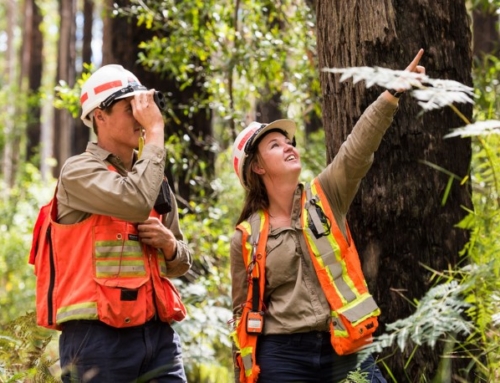
“Forestry Australia is the professional association for forest scientists, managers and other forestry professionals working across Australia’s forests and landscapes,” Dr Freeman said.
“Our members work across conservation, native and plantation forest management, recreation, research, fire management, Indigenous engagement, farm forestry, environmental services and restoration.”
“Our proposed method reflects that breadth. It is not about logging more forests. It is about using carbon investment to support genuine, additional and scientifically demonstrated improvements in forest carbon and forest health and resilience.”
The proposed method is intended to apply across different forest tenures and management objectives, including potentially national parks and conservation reserves, Traditional Owner-managed forests, private forests and state forests.
It recognises that Australia’s forests are diverse, face different pressures and cannot be managed through a single prescription.
Climate change, severe wildfire, drought, pests, invasive species and disease are increasing pressures on forests. In some landscapes, active intervention may be needed to restore forest condition, support regeneration and improve resilience.
“Forest management is not a binary choice between harvesting a forest and leaving it alone,” Dr Freeman said.
“Active and adaptive management in forests includes assisted regeneration, ecological restoration, cultural and prescribed burning, ecological thinning, pest and weed control, protecting habitat trees, post-fire recovery, or changing or deferring harvesting.”
“The intervention should follow the science and the needs of the forest, not a predetermined land-use outcome.”
The proposed carbon method takes a multifunctional, landscape-scale approach, recognising that forests provide multiple values including biodiversity, carbon storage, water, cultural values, recreation and renewable forest products.
Forestry Australia has identified practical examples where carbon investment could support better forest outcomes, including assisted regeneration of Alpine ash forests affected by repeated severe fires and management of heavily stocked cypress pine forests where growth has stagnated.
At the centre of the proposal is a simple principle: carbon credits should reward demonstrated carbon outcomes, not particular land uses.
“The critical question is whether an intervention delivers a genuine, additional and conservatively measured carbon benefit, supported by sound science and environmental safeguards,” Dr Freeman said.
A high-integrity method should therefore include credible baselines, robust carbon accounting, transparent modelling, appropriate treatment of leakage and permanence, environmental safeguards and ongoing monitoring.
Forestry Australia submitted the proposal through the Australian Government process for developing new methods under the Australian Carbon Credit Unit Scheme.
The Emissions Reduction Assurance Committee assessed it as having “excellent alignment” with the Offsets Integrity Standards and suitable for further method development when resources permit.
“Carbon markets can provide important investment in healthier, more resilient forests, but only where the carbon benefits being credited are real,” Dr Freeman said.
“The same integrity test should apply to every project: does it deliver genuine, additional and defensible climate benefit?”
Dr Freeman said Australia also needed a broader conversation about the future of its native forests.
“Reducing this discussion to whether someone is ‘for’ or ‘against’ native forest harvesting does not help us address the complex challenges our forests face.”
“We should instead ask how the best available science can help maintain healthy, resilient forests that store carbon, conserve biodiversity and provide the environmental, cultural, social and economic values Australians expect from them.”
“That is the purpose of Forestry Australia’s proposal.”
“The management should follow the science. The carbon accounting should follow the evidence.”
ENDS
For further information: Jason Ross, Marketing & Communications Manager, M: 0448 190 055
ABOUT FORESTRY AUSTRALIA
Forestry Australia is a not-for-profit professional association representing more than 1,100 forest scientists, managers, professionals and growers. Operating across native forests, plantations, farm forestry and environmental services, our members bring deep scientific knowledge and practical experience in forest, fire, carbon, tree-growing and landscape management. Through their work, they study, manage and care for Australia’s forests and are committed to delivering positive environmental, social, cultural and economic outcomes across all forest types and land tenures.